Comment

I

am walking down the middle of a road wiggling around the little yellow divider reflectors at an empty office park along the redwood shores. I've never seen this place before. never heard of it. it's desolate and strange. a single browned lead is tumbling down the road with me  


There are 4 other people here

each with their dogs


Dog owners


I drempt about my old pug last night

i miss him  

Comment

Comment

Today

I ate an egg tart and debated with my uncle if the paper would light on fire in the toaster oven  

Comment

Comment

July 10, 2014

On the plane leaving San Francisco for Boston...  

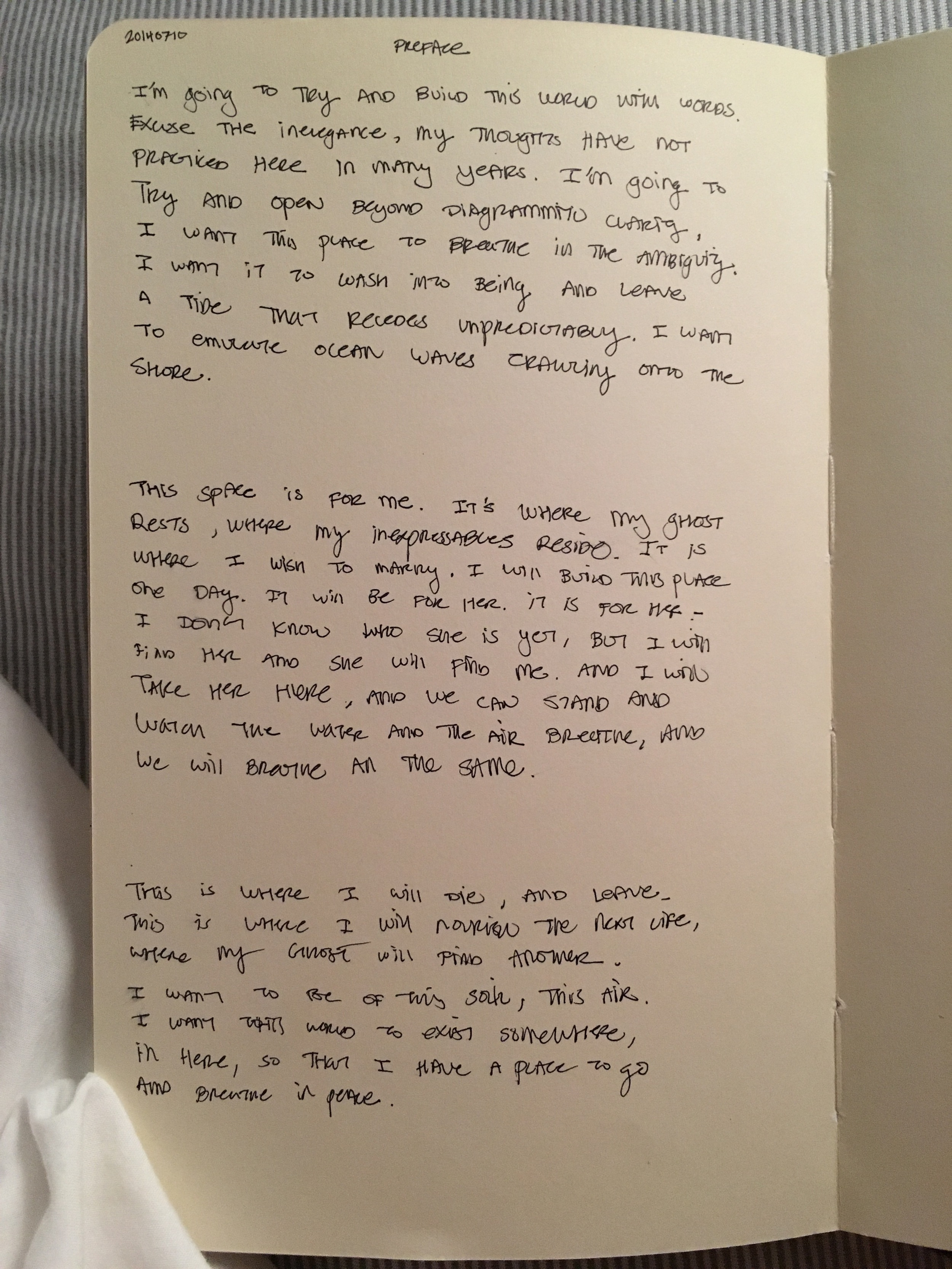
Preface

I'm going to try and build this world with Words. Excuse the inelegance, my thoughts have not practiced here in many years. I'm going to try and open behind diagrammatic clarity. I want this place to breathe in the ambiguity. I want it to wash into …

I'm going to try and build this world with Words. Excuse the inelegance, my thoughts have not practiced here in many years. I'm going to try and open behind diagrammatic clarity. I want this place to breathe in the ambiguity. I want it to wash into being and leave a ride that recedes unpredictably. I want to emulate ocean waves crawling into the shore. 


This space is for me. It's where my ghost rests, where my inexpressible reside. It is where I wish to marry. I will build this place one day. It will be for her. It is for her - I don't know who She is yet, but I will find Her and She will find me. And I will take her here, and we can stand and watch the water and the air breathe, and we will breathe all the same. 


This is where I will die, and leave. This is where I will nourish the next life, where my ghost will find another. I want to be of this soil. This air. I want this world to exist somewhere, in here, so that I have a place to go and breathe in peace...

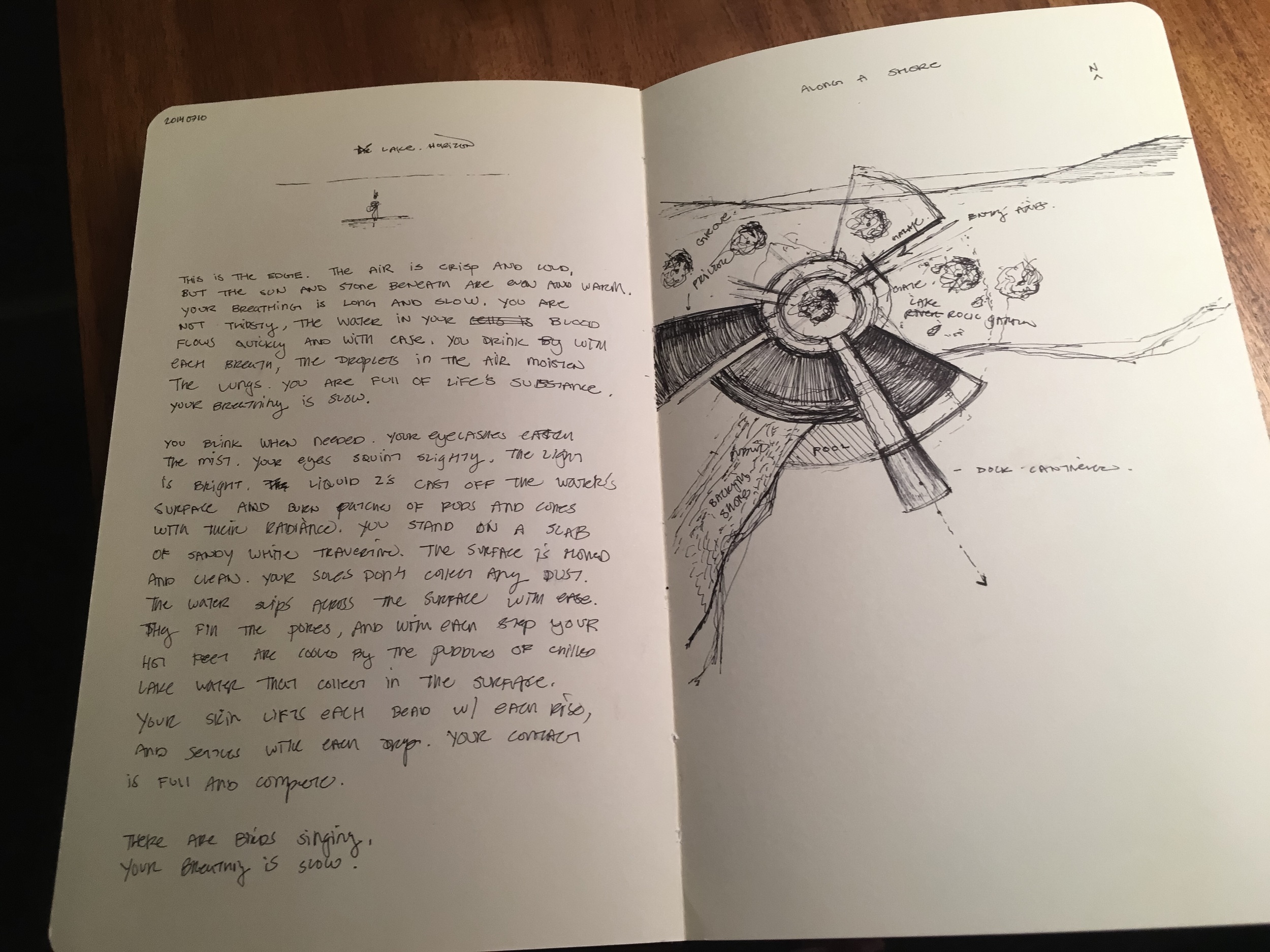
The lake horizon This is the edge. The air is crisp and cold, but the sun and stone beneath are even and warm. Your breathing is long and slow. You are not thirsty, the water in your blood flows quiet and with ease. You drink with each breath, the d…

The lake horizon


This is the edge. The air is crisp and cold, but the sun and stone beneath are even and warm. Your breathing is long and slow. You are not thirsty, the water in your blood flows quiet and with ease. You drink with each breath, the droplets in the air moisten your lungs; you are full of life's substance, your breathing is slow.


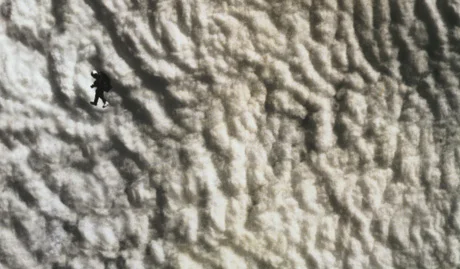
You blink when needed. Eyelashes catching the mist, eyes squinting slightly. The light is bright, liquid Z's off the waters surface and burn patches of rods and cones with their radiance. You stand in a slab of sandy white travertine. Athens surface is honed and cleaned. Your soles don't collect dust the water slips across the skin, fill the pores and cooled by the puddles of lake water . Contact full and complete. 


there are birds singing

your breath is slow  

Comment

Comment

I

m  

laying in bed

staring out the window through the blinds

wind tunnel

but this time filled with white debris 

silk swirling amidst milk cotton laced breeze

i had one beer tonight

and it affected me  

and I'm  


i don't like it  


Comment

Comment

I

got dinner with Gavin tonight. 

We talked about what happens if you lose your backpack on cal train, on unique meanings and interpretations available only through the experience of reading certain languages, on linguistic poetic variability, on friendship, on the power of a single conversation, on detachment, on taking a break from the laptop, on confidence, on Parenting as the act of orchestrating and controlling the boundaries and nature of the fog of war as seen in Starcraft, on memories of what it means to be sharp and funny at 11 years old, on the value of juxtaposition and contrast, on the dangers of monofocussed groupthink, on newspeak, on 1984, on language and the natural pathways towards accessibg certain  ideas, on Croatia, on the fall of the USSR, on sliders, on grown up gifting and picking up the bill, on favors that don't need to be returned, on growth, on maturity, on fear, on ability, on preserverence, 


im standing over my bathroom sink  

elbows leaned on the counter

counting  

the intervals between each pulse

the glint of light in my lower pupil

shining up , almond eye

emotions are a hard thing


Comment

Comment

Today

I drove to Pacific Super,

parked my car,

walked through the right set of doors,

excused me'd past three eager women waiting in line at the super-lotto machine,

saw Don behind the counter, 

smiled and waved Hello,

Tai goes "What you doin here man?"

I commented on the fact that he's growing out his weird goatee again,

He was wearing a burberry scarf and a thick furry jacket indoors.

Something that sounded alot like the DDR Aiaiaia I'm a butterfly song was playing over the intercom,

One of the CDs that has been cycling on loop infinitely since 1980 something.

I saw Judy,

I walked past the hall of fame of shop lifters,

The same mug shots on polaroids

faded from 20 years of fluorescent tube light,

the same lady who looks remarkably bitter,

the same man who smiles and gives a thumbs up to the camera,

the same dude who hoists up in both fists bags of shrimp dripping onto the floor,

he ordered five pounds of ground beef, reached in with his bare hands, removed the beef, left it somewhere on the floor, replaced the beef with five pounds of shrimp and thought he could get away with it,

what a brave soul

a brave soul.

The floor beneath me is speckled linoleum tile, brown, grey, poop, and gold,

Now it is the green carpet.

The green carpet of which my parents always told me not to sit on because the floor was dirty but I did so anyways,

The green carpet I used to build little cardboard houses on for the mice that I wanted to give homes instead of the death-traps that awaited them in the dark storage room with all the files,

I made living rooms, bedrooms, bathrooms, a feeding room, a water cup

I could not bear the thought of us killing the mice when all they needed was a home.

The green carpet that I used to sit in while Ernest held onto the chair and spun it round and round

until I would fall off, nearly throw up, and grasp tightly into the threads of the fibrous floor

holding on to dear life

hoping the earth would stop spinning soon

then shoving pocky and yan-yans into my mouth

and walking up and down the aisles searching for items that were out of place and finding their rightful homes.

I would always find a lone loaf of bread, tumbled and cast-away, tragically helpless, like a toy from Toy Story when all the kids come back and they play dead. I would wonder why the people walking by would see it and not fix it, not put it back. Loaves of bread do not belong on the floor. 

I would always find a bag of chips opened, someone ate a couple chips out of the bag and put it back.

I would find a six pack of coca colas sitting in the tea section, a lazy shopper who changed their mind and abandoned them with no regrets.

I remember the office upstairs,

my dads desk

his chair

the photo of me when I was 3 sitting in his chair, holding a business card with his name scratched out and R o G E r

in its place. 

The little boss

I remember the flowers I gave my mom

Maybe this is one of my first memories

I'm realizing this now

When I was in pre-school, that half chinese half english preschool...

The art teacher was white

She brought us outside one day on a field trip

to pick the tiny flowers we found on the side of the road

I remember sitting in a quiet room

Golden hour light

the type of stillness where you notice single strands of dust falling gently up and around

we took the flowers and placed them between two clear plastic sheets

we built frames out of popsicle sticks

I wrote "i love you mom" in puffy paint

sealed the frame together, sandwiching the poor dry dead flower inside

my mom still has it

she used to hang it above her desk at work

i love my mom

i love my dad

i love my sister

i'm realizing how good it is to be with my family again

i spent the whole day with my sister

we talked about alot of things

i listened to her talking to the managers at the store

i was proud of her

she works so hard

she works so hard for the family

she sacrifices herself for the family

she is selfless

despite how anyone treats her

resilient and loyal

i said this once at her wedding and i'll say it again

i do not know another human being so capable of unconditional love


i'm on my knees at the edge of my bed on the floor

with the laptop at the foot of the bed

chin planted in the furry grey blanket that you like


i want to grow to be someone who can love as my sister loves

as a caring and selfless soul

i want to give you that kind of love

and then extend that love to everyone around me


my friend mezz

just asked me what i'll be doing in LA

I told him I'm here to hang out with a girl that i'm sorta in love with

he responds: 

"love is a beautiful thangggg"


i know this whole thing is totally nuts

but it aint a bad idea

its just a beautiful thangggggggggg


Comment

Comment

I saw 12 Hawks circling over the freeway today

It looked like 12 Icaruses tumbling through space  

Comment

Comment

I searched for [slow] and found [slow] tucked next to [Icarus] in this Cabinet article, "Things That Cannot Be"

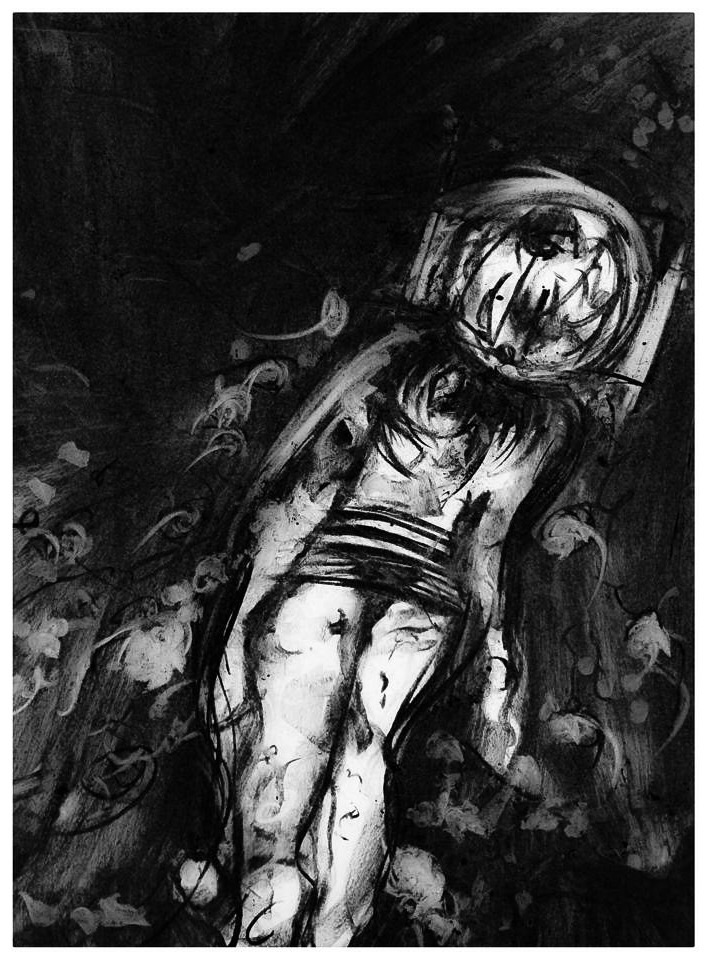
Joe Kittinger falls at the speed of sound, 16 August 1960.

Progress and catastrophe are the opposite faces of the same coin. 
—Hannah Arendt

One thing that distinguishes the older Pieter Bruegel from his contemporaries was his hunch about cosmic distances and his uncanny intuition for what would become known as Newton’s second law of motion. Nothing survives in the painter’s hand to tell us what might have stimulated his farsighted and far-out speculations. But there are clues suggesting that most of what he grasped about inconceivable speeds and tremendous distances he carried away from Abraham Oertel, the gregarious scholar and cartographer Bruegel befriended at the Guild of St. Luke in Antwerp, where they were members. A tip-off to their cozy connection is a perceptive but plainspoken portrait of the painter that Oertel offers in his Book of Friends. In those pages, he declares: “Our Bruegel paints many things that cannot be painted.” And then, in a tone shaded by the knowledge that friendship provides, he observed: “There is often more thinking than painting in his works.” With a very few sentences, Oertel makes transparent that Bruegel was becoming deeply speculative about the role art would play describing the new world order unveiled by the likes of Magellan and Copernicus, but as usual, there is more to his story.

Oertel, who Latinized his name to Ortelius—it’s what scholars did back then—is best thought of as something of an authority on how to visualize complex data sets circa the 16th century. In the wake of Magellan’s voyage to circumnavigate the globe in 1520, and the Copernican displacement of the earth from the center of the solar system 23 years later, Ortelius helped theology, astronomy, and navigation through their uneasy revisions by almost single-handedly advancing the discipline of geography. Antwerp had become home to star cartographers, but among them it was Ortelius who had seen what to do first; take all of the assorted maps, from assorted parts of the world, in their assorted scales, and redraw them in a consistent magnitude, binding them together to create his Theatrum Orbis Terrarum, the world’s first modern atlas. Of course, in the late 16th century the world was becoming a vastly different place and the need to understand the revised cosmic order and all the new continents was suddenly keen. Cartographers were swiftly lifted toward the status they enjoy today. Bruegel, along with other curious minds, wanted to know about the reshuffled cosmos, the dimensions of the real world, and his friend Ortelius would have been a handy and obliging font of information about many things that could not be painted.

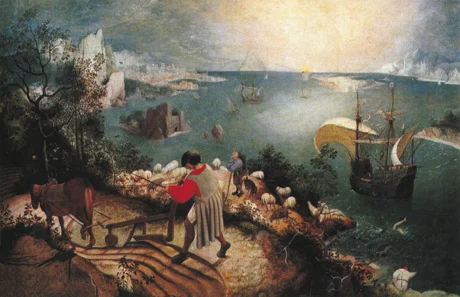
If Ortelius was the key that unlocked Bruegel’s interest in the new cosmic expanse, it was in a painting from 1558 that he tried to convey it. He chose to re-interpret Icarus’s infamous plunge (a subject he had rendered earlier as an engraving), within the new reigning order, where the earth spins inside a vast heliocentric cosmos. In order to accomplish this, Bruegel had to depart from the traditional depiction of the fall. For a moment, think back to Johann Whilhelm Baur’s 1639 engraving of the same harrowing scene. Baur adopted the most conventional of settings for the event: in the noon sky a dazzling sun is in apogee as Icarus begins to tumble, his resistance to gravity has just given way to the frailty of wax. Icarus’s fall is the centerpiece of Baur’s picture, whereas it seems incidental in the Bruegel landscape. Bruegel stressed subordinate details from the myth, and lent large scenes of vita activa principal roles. All there is to be seen of Icarus in Bruegel’s version are flailing legs; splash down occurs—headfirst—at the painting’s lower right. The differences between Baur and Bruegel are notable; they represent Baur’s ignorance, or worse his importunate privileging of an off-the-rack iconography over the revelatory knowledge that had fascinated Bruegel more than 80 years earlier.

Rather than the usual noon hour for the fall of Icarus, Bruegel took the close of the day for his panorama. This decision permitted him the opportunity to construct a modern space-time continuum for his subject. Studying Bruegel’s picture, one would naturally suppose that Icarus drops into the ocean at a spot more or less directly beneath the point in the sky where the sun was positioned when his wings began to fail. Given that Icarus and the sun slip beneath the ocean at the same moment, it is with rough approximation that one can turn the clock backwards, and conclude that Icarus’s flying accident took place at mid-morning, or some six hours before sunset. As they say, the picture is beginning to paint itself. Icarus has fallen an immense distance, taking one-quarter of the day to complete. Bruegel nimbly adjusted the ancient myth and re-tasked the art of painting in order to express the magnitude by which his world had expanded; along the way, he insinuates a revolutionary sense of spatial depth.

“Our Bruegel paints many things that cannot be painted.” Correct, Ortelius. He painted things that could hardly have been comprehended. Certainly Bruegel could not have imagined the complex and punctilious coordinates between speed, space, and time that his picture implied. But to apply Sir Isaac Newton’s second law to Bruegel’s scene is to know that over six hours (looking past the obvious sub-zero temperatures and the absence of oxygen and gravity) Bruegel’s Icarus would have fallen 4,284 miles, attaining a terminal velocity of something like 714 miles per hour, exceeding the speed of sound. It would have been a long and indescribable fall. Or would it?

Triggering the creative license embedded in the myth-form, it is possible to construct a “plausible” account of what Icarus’s trip would have been like upon entering the uppermost region of earth’s atmosphere. At 85,000 feet, somewhere near the middle of the stratosphere—where there is virtually no air—Icarus would have broken the sound barrier. Passing through 50,000 feet toward the bottom of the stratosphere, there would have been enough air density to begin to slow his fall to something like 250 miles an hour. Inside the troposphere at 30,000 feet he would have felt a noticeably warmer atmosphere, and along his route, encountered the air resistance that would slow his fall to 200 miles per hour. At 20,000 feet, or four miles above the earth, the clouds would be approaching very quickly as his airspeed momentarily hovered just above 150 miles an hour. Downward from there, his speed begins a slight decline as his body creates more and more drag through ever-increasing air density. The inevitable end to his journey would come 37.5 seconds later.

This description of Icarus’s plunge is thanks to Joseph Kittinger, Jr. In 1960, four hundred and two years after Bruegel painted his picture, Kittinger took the final portion of Icarus’s trip. Having floated in the gondola Excelsior III for an hour and a half as it slowly made its ascent over the New Mexico desert, he reached an altitude of 102,800 feet, whereupon he stepped out the door into the darkness of space. He was in freefall—like Icarus—but for only four minutes and thirty-six seconds before he cheated death and opened his parachute. That was at about 17,500 feet, the altitude at which Icarus would have been plummeting 220 feet per second towards destiny. For the next eight minutes, Kittinger floated the rest of the way to earth.

While it may sound as if Kittinger was an Icarus re-enactor, he was not a stuntman but a United States Air Force test pilot, assigned to the Escape Section of the Aeromedical Laboratory of the USAF Wright Air Development Division. His jump from above 95 percent of earth’s atmosphere was an experiment designed to provide information about the potential use of parachutes for escape from a space capsule or high-altitude aircraft. At the time, no one knew whether humans could survive a jump from the edge of space, but Kittinger proved it could be done and along the way became the first human to exceed the speed of sound without benefit of an aircraft or space vehicle. With total success on this first jump from such an altitude, no one has thought to attempt a repeat performance. All of his records, from altitude to speed, still stand 50 years hence.

Feet to earth, Kittinger said that his landing zone, the barren New Mexico desert, looked to him as if it were Eden. What must have been feelings of exhilaration mixed with absolute relief are lifted beneath an apparent vision—the apparition of Paradise, after flirting with catastrophe? While his portrayal of accelerating towards Mach One can seem as pensive as a guru’s tale of revelation, he does not leave the impression that his adventure in space made him especially religious, as was the case for some of the astronauts—James Irwin, for instance, went out looking for Noah’s Ark after walking on the moon in 1971. To listen to Kittinger is to hear unambiguous human wonderment and insight into free falling beyond sound’s speed. But it is to also hear Icarus’s voice echoing, as knowledge feathers into myth.

“I fell face to earth for a little ways and I really had no sensation of falling. ... I turned over on my back about this time and I looked up and the balloon was racing into the heavens.” At ease 19 miles above earth, Kittinger rolls over onto his back—as if to lounge about—and witnesses his gondola slipping into a black sky pinpointed by pearl crumbs. With the specter of his silver balloon receding into outer space at a steeply increasing speed, his physiological awareness registered nothing but pure buoyancy. Though falling at the speed of sound, there was no sensation of descent, no sound, but rather the hushed quiet of flight. Plunging at breathtaking velocities, Kittinger felt aloft. Just as we can accept this acute impossibility as a reasoned portrayal of Kittinger’s experience, it can also infuse Icarus’s myth with the scale of reality Bruegel had sought. How to render such a paradox except as an upward fall?


Pieter Bruegel, Landscape with the Fall of Icarus, ca. 1558.


None other than Paul de Man contemplated the resonance of what he referred to as “the imaginative possibility of what could be called anupward fall,” but so too have theologians and physicists and poets, New Age prophets and drug addicts. The upward fall is embedded in and tangled between theology and physics and literature and mores. It exists along the rarified and outermost ring of relativism made legend by Milton’s Satan when he declared “Evil be thou my good.” Either I can repent, Satan reasoned—surrendering selfhood with free will immediately upon being cast out of Heaven—or I will create a relative goodness out of radical evil, which he very well did by doing ill, his sole delight. In this, we grant Satan courage—a morally neutral term—because someone can exhibit willful courage in an act of depravity, as we learned on 11 September 2001. Theupward fall is morally neutral, promising liberation regardless of how dark the calamity, allowing hope to be born within deepest despair; it exhumes goodness from the heart of evil.

The upward fall began as myth, was ultimately extended to knowledge, and finally arches back toward its origins. From de Man to the addict, theupward fall has had a long life deep within mythology. Once it became a powerful portrayal of the knowledge Joe Kittinger gathered passing through the stratosphere, it was ready to be returned to the myth of Icarus divulging the very sort of knowledge Bruegel most wanted to express. Hallucination, a mythical vision, poetry, the grasping of hope out of hopelessness, or Kittinger’s quick assembly of a nascent language to illuminate unprecedented experience? Why yes. Upward fall is an expression perpetually irresolvable, a thing that cannot be.

To conclude, I work backwards. The notion of the upward fall did not first rise to mind pondering Bruegel’s re-setting the Icarus myth, aligning it with legendary discoveries, or of Kittinger’s audacity, which temporarily recast science into mythic language. They are only supporting roles for another episode where we can only pray that it was indeed courage falling along the spine of fear.

The circumstances of this fall can be read about in the span of time it actually took to complete. He was a youngish man, dressed in black pants, dark tie, and French cuffed white shirt. The shirt is noticeably untucked and billowing; his jacket left behind in the apocalypse above the 101st floor. He is pointed head-down, arms at side, left leg momentarily wagging in the wildly flickering air currents that rush by him. In the heat above the 98th floor, it was asphyxiation—rather than immolation—that pressured him to take a decision. Over the course of the jump, his speed never reached more than 150 miles an hour. Such a temperate speed would not have provided blessed unconsciousness, but assured a fatal ending. He jumped alone, although there were those who leaped in pairs, even in groups. His fall would last no more than ten seconds.

In a handful of moments, intractable terror surrenders to unalterable hopelessness and the ten-second plunge is set in motion. As Bruegel before us, our turn at the quixotic has arrived; rendering what is beyond perception, much less understanding. With time to ponder the picture of this plummeting man, a different Dedalus rose to mind, the one who said, near the close of Joyce’s Portrait of the Artist as a Young Man, “I go to encounter for the millionth time the reality of experience and to forge in the smithy of my soul the uncreated conscience of my race.” Where before I heard Icarus in Kittinger’s tale of falling upwardly, Dedalus has now become the window into the heart of this young man, whose white French-cuffed shirt is flailing. This jump from the North Tower—sprung from a place abandoned by hope (otherwise why?)—traveled through an encounter with real experience nearer that of Kittinger than Icarus. If not myth, his experience surely did not survive as knowledge, but will forever soar at the upper reaches of acute relativism where Satan found his goodness too; where liberation can be assured without regard for how foul the tragedy. To believe that his ultimate fate located hope inside hopelessness, and his fear inspired courage, and that like Satan, he too found a qualified goodness within radical evil, is to hope for ourselves. What sort of paradoxical dream could that be, other than our own flight of imagination as we upwardly fall?

Comment